One of the most important tools in our tool belt is our knives. In my previous blog I explained briefly how much I enjoyed redundancy in items I carry. While I always carry a folding knife, in my go bags or backpacking packs I always carry a fixed blade knife. I also have at least one fixed blade knife in the vehicle and several throughout the house.
When it comes to fixed blade knives, few come close to the cost vs performance offered by the Randall’s Adventure, Training and Equipment group ESEE Knives Company. (ESEE Knives | Wholesale Knives Manufactured in the USA ) I have personally carried ESEE knives for four years now. My first purchase was the ESEE 6; and later I ended up completing the collection with an ESEE 3, 4, and 5. ESEE Knives in this series are made from 1095 Carbon steel and boast a 55-57 Rockwell Hardness. ESEE Knives from this series come coated with a textured powder coat. Specific features and more specifications can be found at the link above, I want to get into my personal experience with these knives.

There are many reasons to carry a fixed blade knife in a go bag, whether it is get home bag, bug out bag or as I simply phrase it; “Go Bag.” A fixed blade is one of the most important tools to have in the pack. A fixed blade knife can be used for a multitude of tasks such as, self-defense, dressing animals, batoning wood (I will touch on this more in a different blog), cutting cordage, chopping shrubbery and simply cutting food. While some of these tasks could be completed by a folding knife, a fixed blade will sustain the abuse much better.
During backpacking expeditions I have stopped carrying utensils and instead carry a single spork. When I have food that needs to be cut, I simply clean one of my two knives that I am carrying and use it. Part of every pack is a small container of anti micro bacterial dish soap. Pro-Tip, if you read the bottle its for hand washing too. While out backpacking I have also used fixed blade knives to make feathersticks or batoning firewood.
The ESEE 6 is the first version I purchased in 2014. My initial plan for the ESEE 6 was a backpacking knife that would be able to baton. Upon receiving the knife, I was surprised by the overall quality feel of the knife. The models I have are pre-3d handles, so mine have a “boxy” feel to them. I don’t mind this feel, however, it is worth noting. I am excited to try a 3d handle though. Back on topic, immediately took this knife into the back yard and started batoning firewood. I was pleasantly impressed with how solid the knife felt while striking it with a big ol’ stick. Next, I cut a few pieces of rope and 550 cord. While I wouldn’t expect a knife like the ESEE to have an issue here, I wanted to see how clean the cuts were after batoning. They were clean cuts. I also feathered a stick with the ESEE 6 and that was another simple task for the knife. My ESEE knives have been used for opening many letters, trimming finger and toenails, to batoning wood. I’ll also note here, it’s hard getting the pinky toenail cut with an ESEE 6; it’s not the knifes fault, it’s just the sheer size of the knife that makes it difficult. The ESEE 3 works much better for trimming small toenails. My knives get used; however, I don’t abuse them. I have batoned with all of my ESEE KNIVES however, the ESEE 5 has seen the most use for that task. None of the knives have suffered any harm. The ESEE 3 and 4 were a little on the small side to be batoning, however they excelled at more finesse work like feathering sticks.
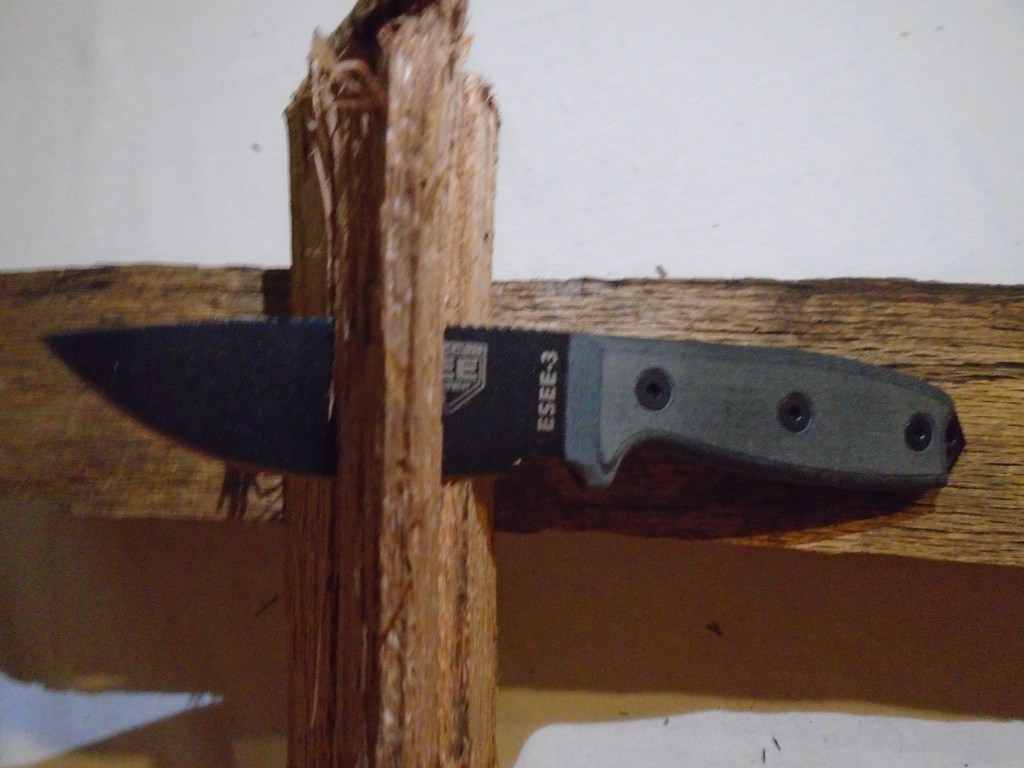
Ultimately, knife preferences come down to personal choice. I recommend ESEE knives because I have good luck with them, I prefer the design, and they are generally tough knives with an impeccable warranty. I also use MORA, Benchmade, and ZT knives as well. ESEE knives have taken over most of my fixed blade knife roles.
In another blog I will discuss why I baton with knives VS a piece of wood.
 Four Horsemen Adventures and Preparedness