A short time ago I posted a blog titled “Vulnerable Communications network, back up comms?” I discussed a few of the reasons I believed having a backup communications network would be beneficial. As a licensed General Class Amateur Radio Operator or also commonly known as “Ham Radio” Operator one of my favorite radios is the Kenwood D74A. This radio is expensive in price but has many useful features. I also utilize a Yeasu VX-6R and a Wouxun KG-UVD1P. Below I will discuss some advantages and disadvantages of these radios.
One of my favorite features of the Kenwood D74 is APRS. Being able to use the APRS.FI app or log onto WWW.APRS.FI and track my handheld and mobile radios is a neat feature. Much like the “Find My IPHONE” app or other tracking methods available on the market. I enjoy giving my parents, friends or other relatives an additional method of seeing where I am, or have been. If I go hiking or backpacking I always let my friends and family know if I will be using APRS. I also will let friends know when I am on road trips if I will be participating in APRS activities. I also enjoy having a dual reception radio so I can transmit on APRS and receive on a different frequency.
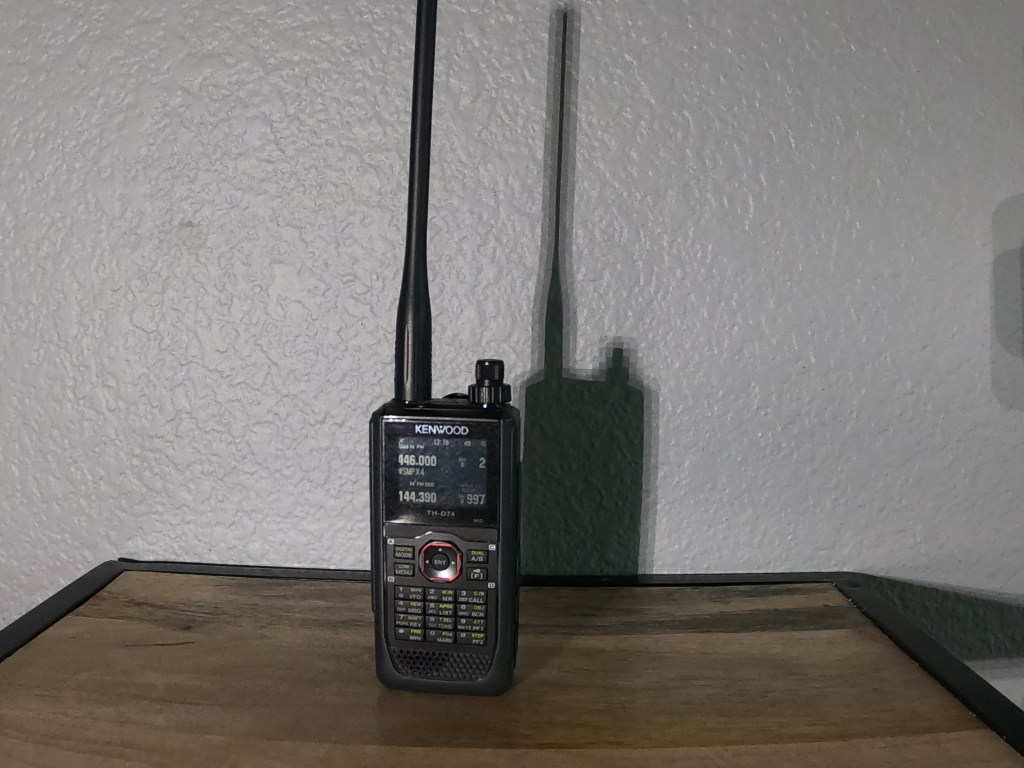
Another feature I enjoy is the dual frequency reception. This allows me to monitor 2 separate bands or frequencies at the same time. With the simple push of a button I can swap between the frequency I am transmitting on and the one I am receiving on to transmit on that frequencies. Further, if I am not transmitting on APRS frequencies, I can monitor any two of the three national simplex frequencies this radio is capable of. Often times I will have APRS operating on one of the bands and then I am either scanning or monitoring a national simplex calling frequency.
The Kenwood D74 is also a DSTAR capable radio. DSTAR is something I have not utilized yet, so I will let more experienced users share information on that. Digital Radios will be a topic of the future, I think they certainly have a place in survival kits along with daily operations.
The D74 is an IEC 529 IP-54/ 55 certified radio. The IP-54/55 ratings imply the radio should survive normal dust ingress and water splashing from any angle. While this rating should suffice for normal rainy day operations and probably work for most people, the reality is I paid $550 for a radio and it is now discontinued. Outside of the traffic accident the D74 was involuntarily involved in, I treat my radio like I butter my toast. Another radio I use in my arsenal is the Yeasu VX-6R. This radio is substantially cheaper ringing in at around $250 however, it is still a solid radio. The VX-6R is the radio I take with me to do things my wife will generally yell at me for. The VX-6R gets treated similarly to my pry bars.
Both the VX-6R and the D74 are tri-band radios featuring capabilities to operation on 144 MHz (2 Meter) 220 MHz (1.25 Meter) and the 420 MHz (70 CM) bands. I like redundancy and having multiple options which is why I always attempt to purchase Tri-Band radios. The availability have having multiple frequency ranges to me is appealing to me. This goes back to my unnatural desire for several layers of redundancy and options.
The Yeasu VX-6R is a single frequency reception radio, unlike the D74 it can only receive on one frequency at a time. The VX-6R is a submersible rated (IPX7) radio, with this rating it should survive the worst of rain storms being certified for submersion in water for 30 minutes at 1 meter deep. The VX-6R is the radio I grab when I go into unique situations. When I was shoveling snow to flush toilets during the great snow storm of 2021, I grabbed the VX-6R. When I stepped outside to look at a tornado, the VX-6R accompanied me.
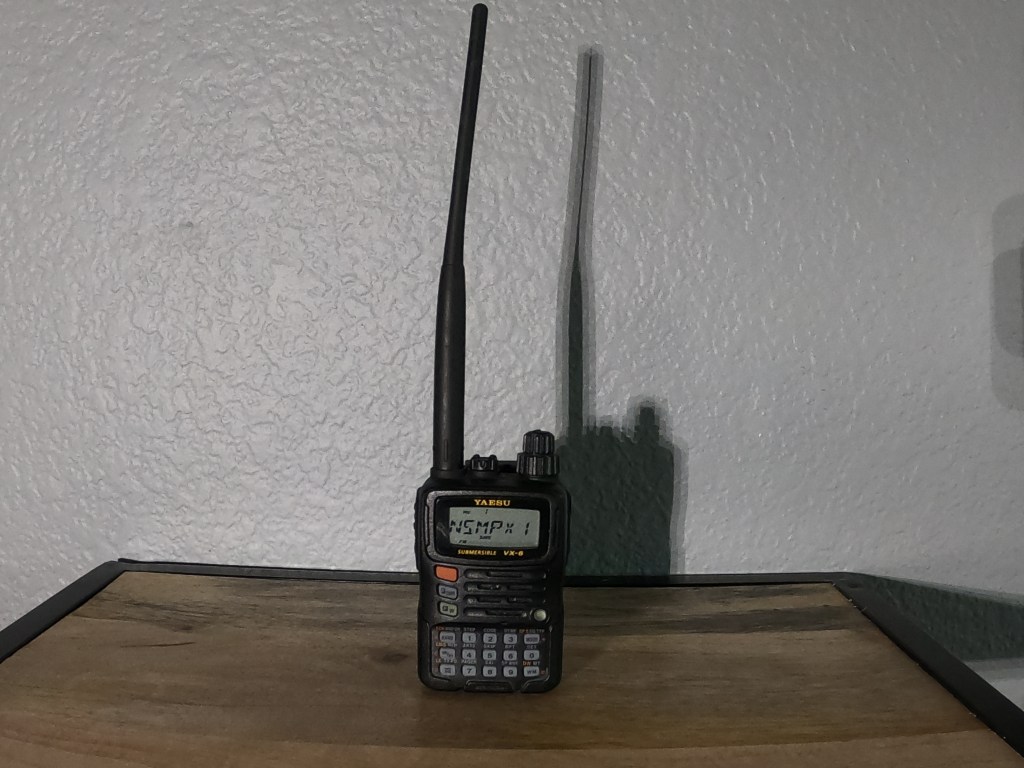
While the VX-6R lacks many of the features the D74 has, APRS, dual receive, and D-Star. The VX-6R is a loud and clear radio, even for someone like me who has some hearing loss. The VX-6R does have the Yeasu EAI (Emergency Automatic ID) function. The VX-6R will automatically transmit your call sign and engage your rigs microphone even if you are disabled. The VX-6R has a two different EAI modes, Continuous and interval mode. A unique feature if the Search and Rescue team is set up to direction find a signal. While the Yeasu VX-6R may not have all of the features of the Kenwood TH-D74A, it is a solid durable radio.
A very good friend and mentor of mine gifted me two radios when I passed my Technicians test, a WOUXUN KG-UVD1P. This is another dual receive radio, however it comes in at currently $120USD. The WOUXUN KG-UVD1P lacks many of the same features as the VX-6R from the D74, however it maintains a special place in my heart as one of the radios that started it all. I have used this radio the most out of all three. The WOUXUN KG-UVD1P is one of the better beginner radios. I found it simple to use once I understood the basics of amateur radio. I would recommend this radio for someone who is just starting out and doesn’t want to drop a significant amount of coin for a full featured radio. I use this radio a lot for monitoring local channels throughout my house. It is also the radio I have the most chargers and batteries for so during times of power outrages it is typically the first radio I will turn on to monitor local repeaters.

The Kenwood D74A, Yeasu VX-6R and WOUXUN KG-UVD1P are very nice radios in their respective class. In my particular case the radios offer a rounded out approach to my collections. In this post I only discussed the features I found important in the radios, I encourage those seeking to expand their radio collection or start it, to decide what’s important. What is found to be important will vary from individual to individual. Submersible or at minimum a significant water and dust protection rating, dual Reception, APRS, tri-Band, AA or AAA battery converters, and desk top chargers and 12v plug chargers is the list of important features for me.
 Four Horsemen Adventures and Preparedness