An aspect of prepping I have always critiqued was our desire to have all the go-fast gear or gear that requires a more in depth understanding of how to use (Tourniquet carriers I am looking at you) and yet we do not train on it. For the previously mentioned tourniquet carriers, when do we apply a tourniquet? When do we take it off? Where are the proper places of application? Where do we apply a tourniquet for a neck wound? Many Tourniquet carriers I ask when we apply one state “When there bleeding a bit” which can be wrong at times. In a recent YouTube video of a riot, bystanders applied a tourniquet to a minor flesh wound caused by a non-lethal rubber projectile……Knowledge provides us the power to act appropriately, along with security, food, survival techniques we need to include medical training in our preparations. I carry a purpose-built medical kit in our EDC Bags.
An often-overlooked aspect of a Get Home Bag, Go Bag, EDC or whichever name you prefer bag is a medical kit. Often, I find medical kits completely disregarded or a simple store purchased kit in these bags. I personally despise store purchased medical kits. Often store purchased kits will state they contain 225 pieces of medical gear; however, 210 pieces are the smallest adhesive bandages available. While adhesive bandages or “Band Aids” serve a purpose and are needed in medical kits, I want a medical kit capable of treating a wide variety of injuries. In my experience most store purchased kits tend to be insufficient of fulfilling all of my goals. My goals when designing and building my medical kits is to have a kit that is sufficient to get me home, maintains my weight limit goals, and is easily restocked along with easy to retrieve equipment from.
I carry enough basic medical supplies provide a sufficient level of medical care to get me to a medical facility for proper treatment or in the case of a total social economic collapse back to my home or shelter. For weight reasons I do not carry medical supplies that will require a significant amount of time or skill level with me. For instance, I do not carry surgical silk spool (For stiches) and instead carry Suture Strips or the equivalents. Ultimately the goal is to stop bleeding. Furthermore being quite wind resistant and not model material, scars do not bother me. Pictured below is my medical kit.
I purchased this outer bag from Adventure Medical Kits. I found the bag to be the perfect size for what I wanted. Here is a link to purchase Mountain Series Custom Medical Kit Bag – Adventure® Medical Kits (adventuremedicalkits.com) Disclaimer: I am not sponsored by, nor do I receive commission from this link. It is a direct link and I have no affiliation with Adventure Medical.
Inside of my bag I carry a pair of Trauma Shears. The Trauma Shears serve a multitude of purposes from cutting my Leukotape and gauze to cutting through cordage, rope or if I need to cut fabric. Being light and incredibly tough it serves its purpose in my kit even though its uses are some what limited. I was able to purchase these shears fairly inexpensively on Ebay.
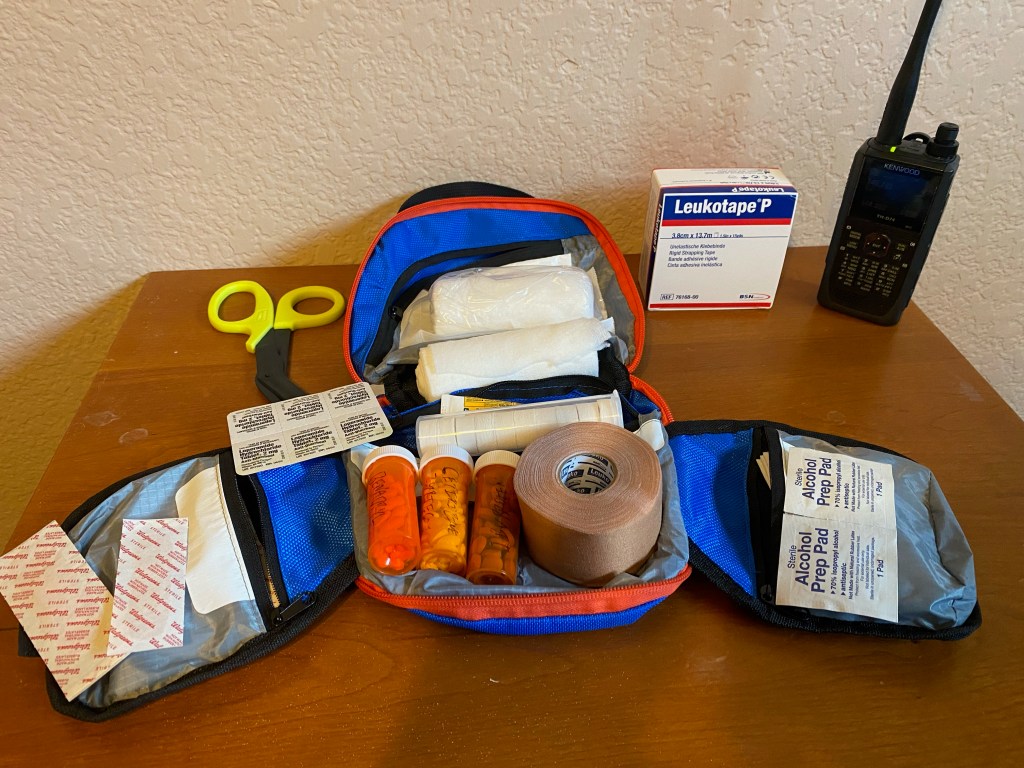
The medications I carry are Ibuprofen, Benadryl, Cetirizine, Neosporin, and Loperamide Hydrochloride (Imodium). First I will address the two different “Allergy” medications. Cetirizine or Zyrtec is a non-drowsy allergy medication that will combat most seasonal allergies. Benadryl is an Anti-Histamine as well. I carry Benadryl for the off chance I discover something in wilderness I did not know I was allergic too. Benadryl can also assist with sleep issues, cold symptoms, skin rash and itching. I carry Ibuprofen for its treatment abilities for pain, fever, and anti-inflammatory properties. Lastly, there is a tube of Neosporin for the minor scrapes and cuts. When I am treating myself I figure I might as well try to prevent an infection as well.
You’ll notice 2 gauze rolls on the top for the more serious injuries. Ultimately it is important to stop the bleed, prevent re-injury and stop infection. Gauze provides an additional barrier. Further instead of carrying gauze tape I plan to utilize the Leukotape that is already in my kit.
Further, you will notice alcohol prep pads off to the left. While saline or pure water is the recommended for cleansing of minor wounds I have a slight Germaphobia problem that defies my knowledge or logic. I figure as light as alcohol prep pads are it cannot hurt to carry them for sterilizing wounds. However there is a second use here, alcohol could also be utilized to sterilize hard objects such as knives, Camelbak drinking spouts and etc . . . . Remember my redundancy problem? Alcohol prep pads can be utilized as fire starters as well.
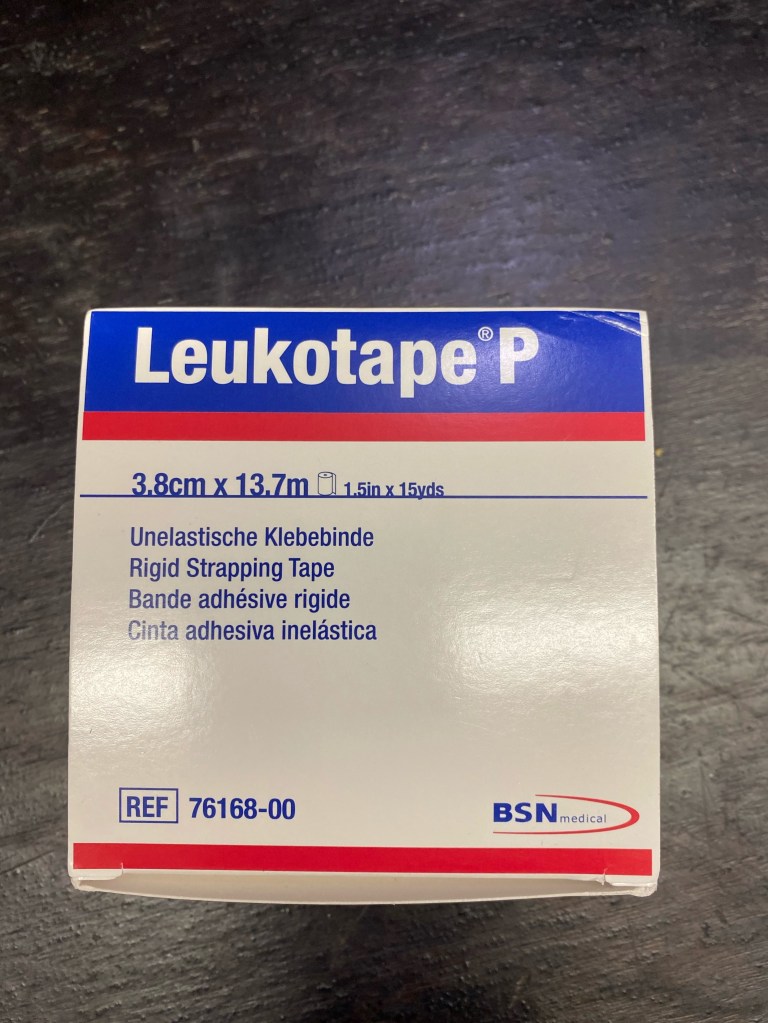
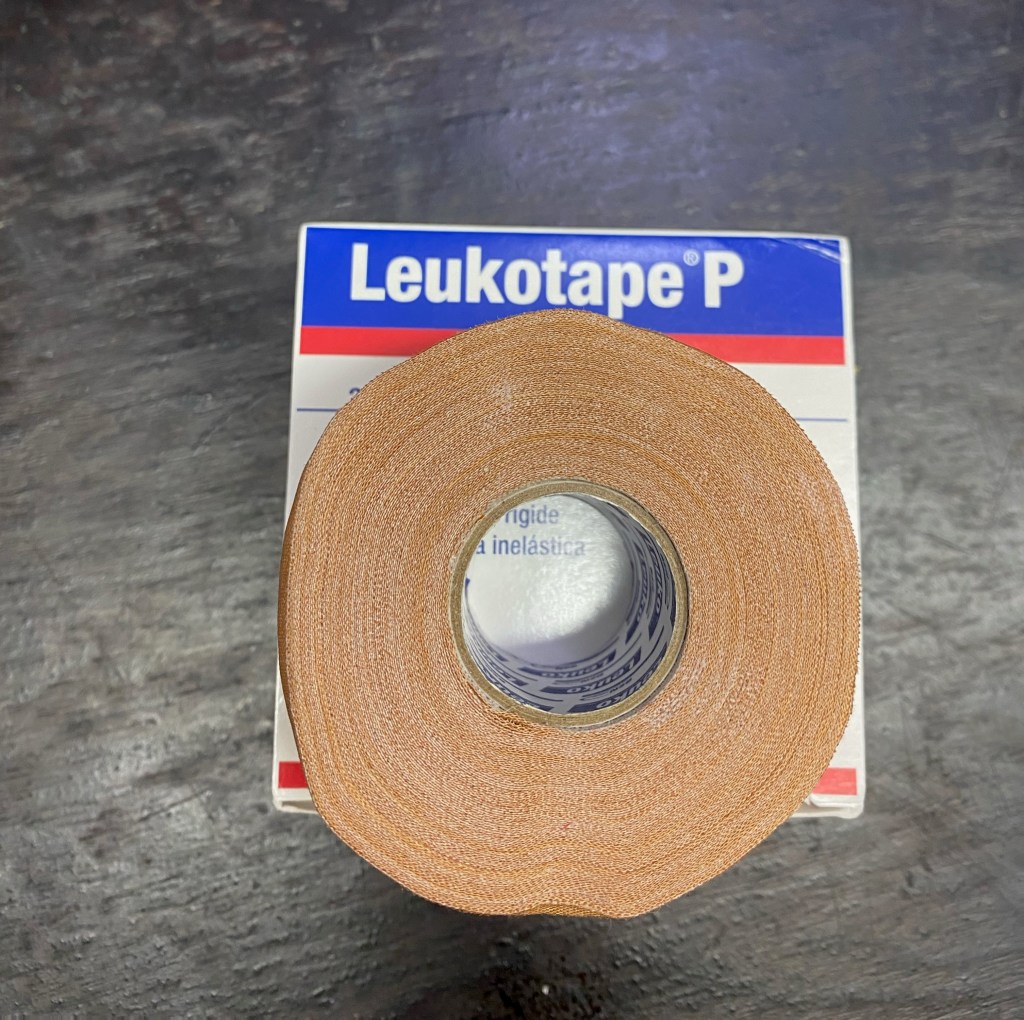
One of the most underrated pieces in my kit and the last item I will talk about is the Leukotape. Leukotape is something I have to order off of EBay and for some reason no local store I can find carries it. However it is the most versatile tape I have ever found. Leukotape utilizes a zinc oxide adhesive that once placed will stay in place for hours. Leukotape was originally designed for sports taping or assisting body mechanics and preventing further injury. Many hikers have adapted Leukotape and gauze to prevent blisters or prevent further injury to blisters. Personally, when I feel hot spots forming in my feet I stop as soon as possible and cover with Leukotape to prevent blisters and have plenty of success. Further with Leukotape adhesive properties I have used Leukotape like gauze tape to keep gauze in place. I have also used Leukotape to treat ankle, knee, and wrist sprains. Leukotape replaces the need for gauze tape, ace bandages, mole skin and in many cases, adhesive bandages. Having so many uses for Leukotape is the reason I carry a full, or close to full roll in my bag. There are two versions of Leukotape, I personally carry the P version. There is also a K version that is more like Kinetic Tape. This product is one that I recommend without hesitation and hope you experiment with to see if you like.
My Medical kits are simple and cover many reasonable injuries I expect to receive. Starting with the simplest items. I carry Adhesive bandages in a variety of sizes. I carry “Waterproof adhesive bandages” to try and prevent the adhesive bandage from falling off with sweat or water. The purpose in which we carry adhesive bandages is a wildly discussed topic. I still follow the opinion for a short time at least, minor wounds need moisture to heal. I also feel better having a band aid keeping antibiotic ointment on my wound. Generally speaking I will only use adhesive bandages for a short time. Once I am in a more sterile environment I will let them air dry with more anti biotic ointment on. Depending on the extent of the injury I may apply another adhesive bandage before the next day’s activities to prevent further injury. My biggest hope is to prevent introduction of a bacterial infection from nature.
A final note, no content in the blog is meant to substitute proper medical care. I am not a doctor, nor do I hold any specialized training, certifications, or licenses in the medical profession. The opinions expressed below are an expression of what works for me. Medical care should be considered a specific plan to everyone. I advise everyone to go over a proper medical care with their Primary Care Physician or other medical profession.
The Disclaimer: I am not an outdoor survival expert, A Lawyer, A Doctor or a Medical Professional of any type nor do I hold any professional certificates of training, licenses or education in the topics of outdoor survival, Judicial Law or Medical. The opinions expressed here are a reflection of what I implement to care for myself and what I find works for me. I encourage everyone to do their own research and formulate their own plans with a proper medical professional such as your primary care physician. None of the techniques provided in my blog is a substitute for proper medical care.

